
| What We Race |
|
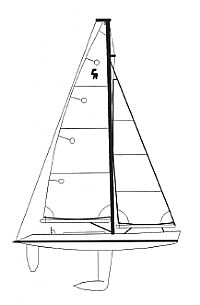
CR 914 - One Design The CR 914 is based on the original design of the International America's Cup Class.This one design class allows no variations in hulls, spars, sails or replacement parts. 36" (914mm) long, 658 sq. in. sail area, 6.25 lb displacement.
​The 914 millimeter long CR 914 is based on the original design of the International America's Cup Class. Because the CR 914 is relatively inexpensive and can be purchased fully built or can be assembled from a kit without special skills or tools, it qualifies as an entry-level class. A high performance racing machine that accelerates quickly, turns on a dime and points like a tour guide. It sails well in an extremely wide range of wind velocities, without having to use multiple rigs for light and heavy air like some other classes must do. Weighing only 6.25 pounds and carrying 658 square inches of sail area, it ghosts amazingly well in the lightest of air. Ballasted by over three pounds of lead in the streamlined bulb at the end of its deep fin keel, however, this remarkable little boat readily handles a 20 knot wind and can keep racing in gusts to 30 without shortening sail. The hull and deck are cast as one piece of ABS plastic. The high-aspect-ratio foil-shaped rudder and keel fin are molded with their shafts installed. The spars are made of aluminum tubing, the keel bulb is a shaped lead casting, and the sails are dye-cut from lightweight rip-stop polyester spinnaker cloth. Kits come from the US distributor with complete electronics, a boat stand, epoxy and cyan acrylic glue, and an "upgrade package" that has been developed in the United Stares to overcome a few minor shortcomings in the original kit that were identified early in our experience with the boat. You get all the parts, reinforcing materials, fasteners and everything else you need to build and sail the CR 914 except sandpaper and batteries. Oh, yes, before you can go sailing you also need some water. Kits, partially built boats, finished boats ready to sail, and boats with custom paint jobs and special graphics can be ordered from the US distributor, Chesapeake Performance Models, which also carries a full line of parts and accessories. Class Website | ||||||||
|
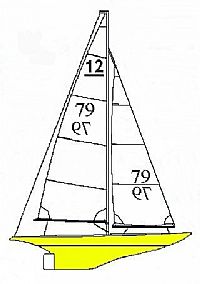
EC-12 - One Design Based on a 1962-63 vintage design for a full-size International 12 Meter. This medium-sized yacht's hull must be initially purchased from a licensed builder. Decks and sails are strictly controlled, purchased or made from scratch. Almost all other equipment is up to the owner. Approx 58" long.
The EC-12M is one of the one-design classes comprising the AMYA-recognized fleet. Class specifications govern virtually every aspect of these yachts from hull and sail design to permitted remote controlled functions. Approximately 5 feet long, with a mast standing about six feet over the deck, the EC-12M weighs in at about twenty-three pounds. Originally a towing tank model for a Charley Morgan twelve meter, the EC-12M can be transported in all but the smallest of cars, sailed in shallow waters, and in winds from mere zephyrs to light gales. The hull is shaped so as to shed dead leaves and other flotsam, an important feature when sailing on inland lakes and ponds. Class Website | ||||||||
|
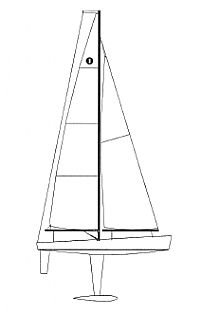
IOM - One Design Sanctioned in 1998. The International One Metre is the fastest growing class in the world. The rules in this class are identical to those used throughout the globe. The class has a one-design rig and weight minimums, but the hull design is very much developmental. One meter long, with a sail area as large as a Marblehead. 39.37" long (One meter)
The versatile International One Metre (IOM) is one of the most popular class in the radio sailing world, and many USA sailors enjoy regular travel for competition. Others prefer local sailing, and local fleets are the class backbone. USA's annual Nationals began in 1998. The class formed in the late 1980s, specifying three (3) one-design rigs with the hull/foils controlled by box rule. This format encourages evolution and created our highly refined fleet of today, where creative skippers continue to test new ideas. We race in the lightest breeze up to very strong winds and waves, where we need our smallest rig up to 35-40 knots. The hull weight limit allows amateur designers/builders to carefully create competitive IOMs and test their mettle against the best commercially available. Besides our plethora of purchase options, we have a recent global boom in home-built woody hulls now too. While the most skilled skippers usually win the regatta, no single design dominates our World Championships on even years.
Class RulesClass Website | ||||||||
|
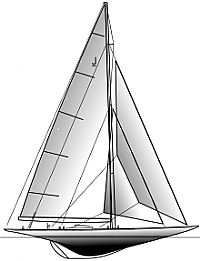
J Class - One Design The J class yachts are 1/16 scale versions of the original 1930's J-boats only, making it the largest of all the RC yachts. These classic yachts recreate the style of yachting's Golden Era, on a grand but affordable scale.
Approx. 85-95" long. The largest class in the AMYA, the "J" boat
The J Class models are 1/16th scale hulls of the J Class yachts that sailed for the America's Cup from 1930 through 1937 as well as the yachts that were converted to the J Class and competed with the America's Cup yachts in club regattas. The models are the largest recognized class in the AMYA with hull lengths ranging from about 7 feet in length to 81/2 feet in length and weighing between 65 and 90 pounds. The models carry from about 3,000 to 4,000 square inches of sail on masts that are 8 to 91/2 feet above the deck. The difference in sizes of the models is driven by the different sizes of the full size yachts. The Js were designed to a rule with a specific formula that allowed the designers to change dimensions of the hulls and sail area to arrive at the same answer. The full size yachts varied in size from about 120 to 135 feet in length and had waterline lengths from about 76 to 87 feet and carried a crew of about 35 professional sailors.
Class RulesThere were ten yachts built to the J specifications between 1930 and 1937, six in America and four in Britain to compete for the America's Cup. Another eight existing large yachts sailing at the time were converted to J specifications for use as trial horses and as competitors in local yacht club regattas. Drawings for all of the original J yachts and those converted to the J class are available from several museums such as the Mystic Seaport Museum, the Smithsonian and the Herreshoff Maritime Museum. There are also several companies producing fiberglass hulls for some of the yachts. The hulls that are currently available in fiberglass are Ranger, Endeavour, Shamrock V and Whirlwind. The scratch building of hulls from drawings in either fiberglass or wood is encouraged in the class. Masts and spars in extruded aluminum are also available for skippers who wish to build their J model. Keep in mind that there will be some scratch building required when you build your J model regardless of whether you begin with a fiberglass hull or want to build a plank on frame model. The J Class is truly one of the most beautiful class of models in the AMYA reflecting the sailing power and grace of the original classic yachts of the 1930s. | ||||||||
|
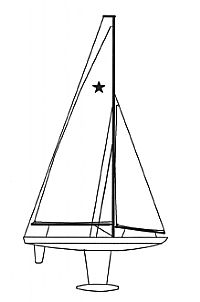
Star 45 - One Design Based on the full-sized Star Class of Olympic and International fame. Builders are allowed variability in materials but dimensions are closely controlled. 45" long.
The Star 45 has a 45" long hard-chine hull; it is a semi-scale model of the full-size International Star. Weighing from 12 to 13 pounds, carrying about 1000 square inches of sail area and with a ballast to weight ratio approaching 70%, Star 45s are fast and responsive. When properly trimmed, the boat will sail hands off to windward. A Star 45 is fun to build, and like the full-sized Star boat, it was designed to race. It has a rubber bumper on the bow to avoid damaging other boats.
A Star 45 can be homebuilt from wood or fiberglass with plans available from the American Model Yachting Association. Laser-cut frames based on those plans can be purchased, or major hull components in fiberglass can be obtained from Class suppliers. One can also commission a new Star 45 from a professional builder to any stage of completion. The Star 45 is a one-design class, but some tolerance is allowed with the underwater appendages, rig construction and sails.
You can register or transfer a boat online via the link on this page, or if you prefer the paper form, you can find either method on the Star 45 Class website at star45class.com
Class RulesClass Website | ||||||||